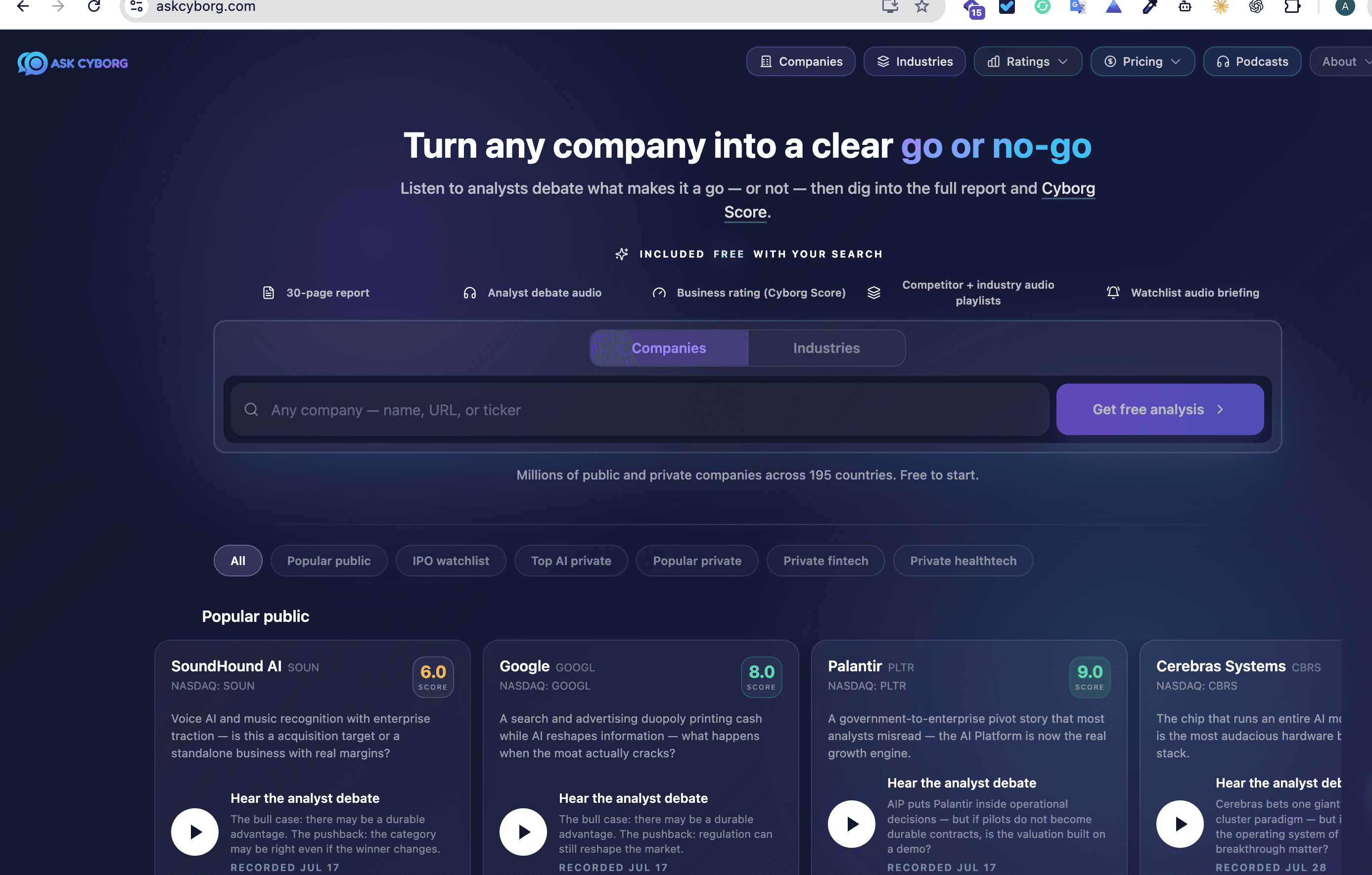
Project overview
AskCyborg helps investors, founders, analysts, operators, and other professionals decide whether a company is a go or no-go.
Rather than stopping at raw company data, the product organizes research into a decision package containing a strategic report, competing analyst perspectives, competitor and industry context, risk analysis, audio, and a 1–10 Cyborg Score.
The challenge
Company research is fragmented across financial documents, disclosures, market reports, news, industry context, and operational signals.
The experience needed to simplify that material without hiding uncertainty, overstating confidence, or preventing expert users from inspecting the supporting reasoning.
The solution
Structured the experience around progressive depth: discover a company, review its thesis and score, hear opposing arguments, inspect the complete report, explore competitors, and save it for monitoring.
Combined a decision-first interface with a multi-agent analyst-debate framework so users can scan a conclusion quickly while retaining access to caveats, competing views, methodology, and deeper evidence.
My contribution
- Designed a decision-first product hierarchy around company search, the Cyborg Score, company theses, and analyst debates.
- Created repeatable browsing patterns for public companies, private companies, industries, IPO watchlists, and thematic collections.
- Designed progressive research flows spanning quick summaries, long-form reports, audio debates, competitor playlists, and watchlist briefings.
- Developed the responsive web product experience represented in the supplied project brief.
Key features
- 1–10 Cyborg Score
- Bull-versus-bear analyst debates
- Strategic company reports
- Global company search and discovery
- Competitor and industry playlists
- Watchlist audio briefings
- Free, Pro, and Team research workflows
Technical challenges
Simplifying company evaluation without oversimplifying it.
Paired the headline score with a thesis, opposing analyst perspectives, a detailed report, methodology, and supporting context.
Building trust in AI-generated strategic analysis.
Made disagreement, caveats, recorded dates, research sources, and evaluation methodology visible throughout the experience.
Serving casual visitors and professional researchers together.
Used progressive disclosure so a user can obtain a fast summary or continue into reports, audio, comparisons, and monitoring.
Architecture
- Decision-first responsive web experience
- Multi-agent analyst-debate workflow
- Score, report, audio, discovery, and monitoring product layers
- Freemium subscription model with deeper Pro and Team workflows
Outcome
Delivered a live product experience positioned between a company database, an analyst report, and a business-intelligence podcast.
Product screens